
Make reports, invoices, and ads from data
Give this prompt to your AI agent. The agent does the task for you.
Read https://thirds.ai/docs/integrations/api-workflows and help me map my report, invoice, or ad data to a saved template and run this recipe with one approved render and safe retries
Turn one approved set of data into a branded file, then keep the job ID with your source record. These recipes use curl and the thirds.ai HTTP API. Your app supplies the data, and the recipe creates and checks the output. The recipes don't connect to your reporting tool, accounting system, or ad account for you.
Generate a branded PDF from n8n, Zapier, or Make
There is no published n8n node, Zapier app, or Make app for thirds.ai. Each tool reaches the same HTTP API through its own generic request action:
| Tool | Action to use |
|---|---|
| n8n | HTTP Request node |
| Zapier | Webhooks by Zapier, the Custom Request action |
| Make | HTTP module, the Make a Request action |
Set the method to POST, the URL to https://thirds.ai/v1/pdf, and add an Authorization: Bearer YOUR_API_KEY header with Content-Type: application/json. Send your saved template's ID, version, and data as the JSON body. This is the same report template the Map a report section below uses:
{
  "template_id": "tpl_00000000000000000000000000000000",
  "version": 1,
  "data": {
    "period": "October 2026",
    "title": "Monthly campaign report",
    "summary": "A clear view of this month's campaign performance.",
    "metric_label": "Paid social conversions",
    "metric": "+31%",
    "metric_note": "Warmer creative and a tighter audience list.",
    "next_step": "Scale the winning carousel.",
    "footer": "Prepared by your team",
    "primary_colour": "#0a46ff"
  },
  "wait": false
}
Read status from the response. Poll GET /v1/pdf/{id} with a delay until it reads succeeded, failed, or cancelled. Give each workflow run its own Idempotency-Key header, such as the report period or invoice number. Then a retried step never bills a second file. The invoices and reports use-case pages show the full field list for each template. The HTML to PDF page covers the request and response rules that every document shares.
Prepare the recipe
You need curl and jq on macOS or Linux. Set THIRDS_API_KEY through your secret store using a key from your account. Keep the key, request data, and work folders private and outside source control.
Choose the report, invoice, or ad below. Open its Template HTML and sample data link and copy the HTML into /private/work/report.html. Create /private/work first, or use a private directory on your server. This command wraps the HTML in a request body. It makes no AI call and no render:
umask 077
jq --raw-input --slurp '{source: .}' /private/work/report.html \
  > /private/work/report-template.json
Save the prepared template through the API:
curl --fail-with-body --silent --show-error https://thirds.ai/v1/templates \
  -H "Authorization: Bearer $THIRDS_API_KEY" \
  -H 'Content-Type: application/json' \
  --data-binary @/private/work/report-template.json \
  --output /private/work/report-template-result.json
Keep the returned template id and latest_version with your workflow. This save does not render an output. If the save response is lost, check your template list before you save another copy. Use an exact version in each render so a later edit does not change a retry.
Map a report
Source: your approved campaign summary. Result: an A4 PDF for your client or team.

| Source value | Template data field |
|---|---|
| Reporting month | period |
| Report heading and summary | title, summary |
| Metric name, value, and explanation | metric_label, metric, metric_note |
| Approved next action | next_step |
| Team name and brand colour | footer, primary_colour |
The picture shows the gallery's sample values. Replace them with facts from your report. The recipe does not calculate or verify campaign performance.
Map an invoice
Source: a final invoice from your billing system. Result: an A4 PDF for the customer.
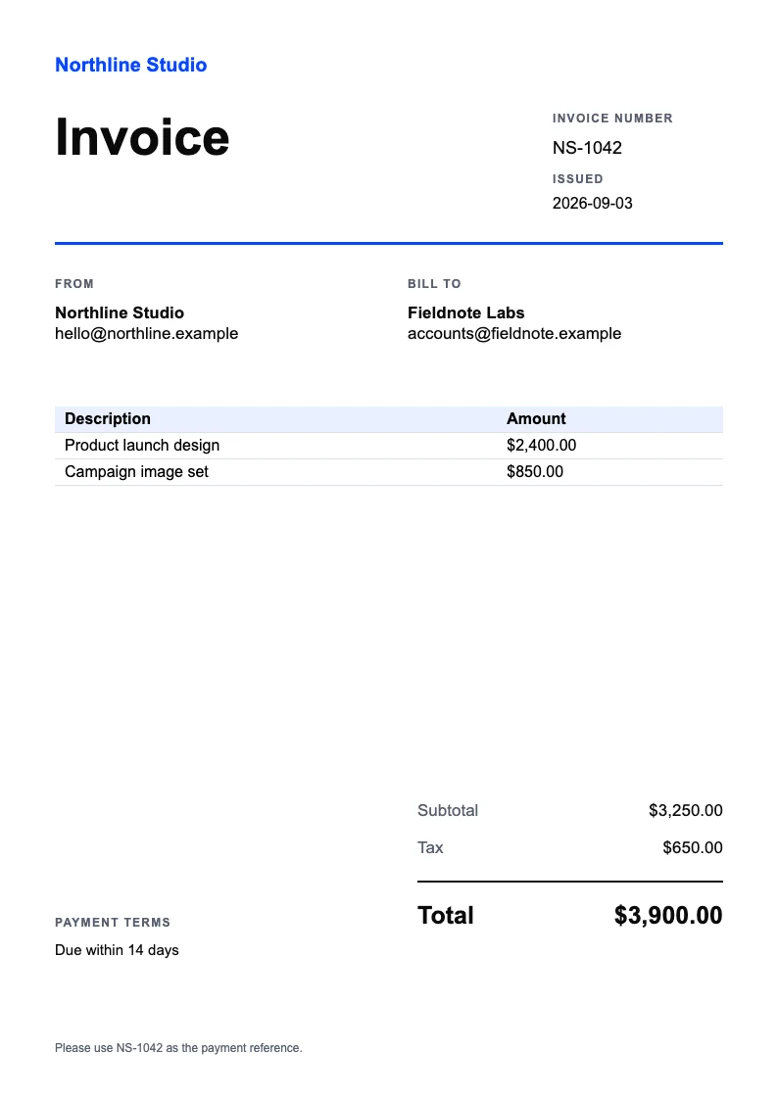
| Source value | Template data field |
|---|---|
| Sender name and email | business_name, business_email |
| Customer name and email | client_name, client_email |
| Invoice reference and date | invoice_number, issued_on |
| Each item description and amount | items[].description, items[].amount |
| Calculated amounts | subtotal, tax, total |
| Due terms and payment reference | payment_terms, payment_note |
Copy this template's HTML in the prepare step. Your billing system owns taxes, currency, and totals. The template displays those values. Check its source and currency format before you save it for your business.
Map an ad
Source: an approved product offer. Result: a 1080 × 1080 PNG for your creative review.

| Source value | Template data field |
|---|---|
| Brand name | brand |
| Offer headline and supporting text | headline, supporting_line |
| Pack size or price label | price_label |
| Display price | price |
| Action text | action |
| Product picture and graphic logo | product_image, logo |
Copy this template's HTML in the prepare step, and send the create request to /v1/image. The sample uses a bundled product picture and logo. Set product_image and logo to public HTTPS image URLs for assets you own. Changing the text alone does not change those pictures. The recipe creates an image. It doesn't publish or buy an ad.
Create and check the file
Put your values in the data object. Use the fields from the template's sample data. Replace the ID and version with the values from your saved template. Choose one Idempotency-Key for this output, such as the report period, and save it with your source record.
Review the request before you run it. This command starts a billed render. See credits and billing for costs.
curl --fail-with-body --silent --show-error https://thirds.ai/v1/pdf \
  -H 'Authorization: Bearer YOUR_API_KEY' \
  -H 'Content-Type: application/json' \
  -H 'Idempotency-Key: report-2026-10' \
--data '{"template_id":"tpl_00000000000000000000000000000000","version":1,"data":{"period":"October 2026","title":"Monthly campaign report","summary":"A clear view of campaign performance this month.","metric_label":"Paid social conversions","metric":"+31%","metric_note":"Warmer creative and a tighter audience list.","next_step":"Scale the winning carousel.","footer":"Prepared by your team","primary_colour":"#0a46ff"},"wait":false}'const response = await fetch("https://thirds.ai/v1/pdf", {
method: "POST",
headers: {
"Authorization": "Bearer YOUR_API_KEY",
"Content-Type": "application/json",
"Idempotency-Key": "report-2026-10"
},
body: JSON.stringify({
"template_id": "tpl_00000000000000000000000000000000",
"version": 1,
"data": {
"period": "October 2026",
"title": "Monthly campaign report",
"summary": "A clear view of campaign performance this month.",
"metric_label": "Paid social conversions",
"metric": "+31%",
"metric_note": "Warmer creative and a tighter audience list.",
"next_step": "Scale the winning carousel.",
"footer": "Prepared by your team",
"primary_colour": "#0a46ff"
},
"wait": false
}),
redirect: "error",
signal: AbortSignal.timeout(30000),
});
if (!response.ok) throw new Error(`HTTP ${response.status}; Retry-After: ${response.headers.get("retry-after") ?? "none"}`);
console.log(await response.text());import json
from urllib.error import HTTPError
from urllib.request import HTTPRedirectHandler, Request, build_opener
class NoRedirect(HTTPRedirectHandler):
def redirect_request(self, req, fp, code, msg, headers, newurl):
return None
request = Request("https://thirds.ai/v1/pdf",
method="POST",
headers={
"Authorization": "Bearer YOUR_API_KEY",
"Content-Type": "application/json",
"Idempotency-Key": "report-2026-10"
},
data=json.dumps({
"template_id": "tpl_00000000000000000000000000000000",
"version": 1,
"data": {
"period": "October 2026",
"title": "Monthly campaign report",
"summary": "A clear view of campaign performance this month.",
"metric_label": "Paid social conversions",
"metric": "+31%",
"metric_note": "Warmer creative and a tighter audience list.",
"next_step": "Scale the winning carousel.",
"footer": "Prepared by your team",
"primary_colour": "#0a46ff"
},
"wait": False
}).encode("utf-8"),
)
try:
with build_opener(NoRedirect()).open(request, timeout=30) as response:
print(response.read().decode("utf-8"))
except HTTPError as error:
retry = error.headers.get("Retry-After", "none")
raise RuntimeError(f"HTTP {error.code}; Retry-After: {retry}") from NoneFor the ad, send the same body to /v1/image and add "image":{"format":"png","width":1080,"height":1080}.
Save the returned job id with your source record. If the response gets lost, send the same command again with the same key and body. You get the same job back, and you pay once. The key protects you for 24 hours. After that, check your renders before you create again.
Read the job until status is succeeded, failed, or cancelled. Wait between reads and stop at your own deadline:
curl --fail-with-body --silent --show-error \
  https://thirds.ai/v1/pdf/pdf_00000000000000000000000000000000 \
-H 'Authorization: Bearer YOUR_API_KEY'const response = await fetch("https://thirds.ai/v1/pdf/pdf_00000000000000000000000000000000", {
method: "GET",
headers: {
"Authorization": "Bearer YOUR_API_KEY"
},
redirect: "error",
signal: AbortSignal.timeout(30000),
});
if (!response.ok) throw new Error(`HTTP ${response.status}; Retry-After: ${response.headers.get("retry-after") ?? "none"}`);
console.log(await response.text());import json
from urllib.error import HTTPError
from urllib.request import HTTPRedirectHandler, Request, build_opener
class NoRedirect(HTTPRedirectHandler):
def redirect_request(self, req, fp, code, msg, headers, newurl):
return None
request = Request("https://thirds.ai/v1/pdf/pdf_00000000000000000000000000000000",
method="GET",
headers={
"Authorization": "Bearer YOUR_API_KEY"
},
)
try:
with build_opener(NoRedirect()).open(request, timeout=30) as response:
print(response.read().decode("utf-8"))
except HTTPError as error:
retry = error.headers.get("Retry-After", "none")
raise RuntimeError(f"HTTP {error.code}; Retry-After: {retry}") from NoneWhen the job succeeds, copy download.url from the response and add https://thirds.ai before it. The download doesn't need your API key:
curl --fail --silent --show-error \
  'https://thirds.ai/v1/downloads/YOUR_SIGNED_DOWNLOAD_TOKEN' \
--output report.pdfimport { writeFile } from "node:fs/promises";
const response = await fetch("https://thirds.ai/v1/downloads/YOUR_SIGNED_DOWNLOAD_TOKEN", {
method: "GET",
headers: {},
redirect: "error",
signal: AbortSignal.timeout(30000),
});
if (!response.ok) throw new Error(`HTTP ${response.status}; Retry-After: ${response.headers.get("retry-after") ?? "none"}`);
await writeFile("report.pdf", Buffer.from(await response.arrayBuffer()));import json
from urllib.error import HTTPError
from pathlib import Path
from urllib.request import HTTPRedirectHandler, Request, build_opener
class NoRedirect(HTTPRedirectHandler):
def redirect_request(self, req, fp, code, msg, headers, newurl):
return None
request = Request("https://thirds.ai/v1/downloads/YOUR_SIGNED_DOWNLOAD_TOKEN",
method="GET",
headers={
},
)
try:
with build_opener(NoRedirect()).open(request, timeout=30) as response:
Path("report.pdf").write_bytes(response.read())
except HTTPError as error:
retry = error.headers.get("Retry-After", "none")
raise RuntimeError(f"HTTP {error.code}; Retry-After: {retry}") from NoneCheck the file against the job's artifact.byte_size and artifact.sha256 before you deliver it. On macOS, use shasum -a 256 for the second command:
wc -c report.pdf
sha256sum report.pdf
Open the file and check its content too. Keep the job ID, byte size, and SHA-256 with your source record.
If a job fails, follow retry and download recovery. Don't start a new render just because polling or a download stops. Read the same job again for a fresh link, then download it again.
After collection, store the file in S3 or R2, or use webhook delivery for a server workflow.
Use the same recipe with an agent
Connect your client with the MCP setup guide. Give the agent your saved template ID, exact version, and approved data through your private workspace. Ask it to show the proposed output and cost before it calls render.
For this task, the agent uses render with the same template data, saves its idempotency_key and returned job ID, then reads get_status until the job ends. It collects and verifies the successful file. A timeout resumes the same operation. It doesn't authorize another render. API and MCP use the same account credits. Keep the source record linked to one job when switching clients.
Use this prompt after you supply your saved report template ID, version, and private data file:
Use my saved report template and its exact version to make one PDF.
Read my approved data from the private file I provide.
Show the template ID, version, data mapping, and expected credit cost first.
Wait for me to approve the one-credit sample render before you call render.
Save one idempotency key and the returned job ID with this source record.
If the call loses its response, reuse that key and the same arguments.
Do not retry an uncertain create after its 24-hour protection ends.
Use get_status to check the same job until it ends.
Download the successful file and check its size and SHA-256.
Show me the file before any customer delivery.
Do not create or publish a template, call an AI build tool, or start another render.
For a direct client check, the MCP Inspector CLI supports Streamable HTTP, saved server configuration, and tool calls. Configure a server named thirds with the URL https://thirds.ai/mcp, transport streamable-http, and your authorization header in a private file. Follow the Inspector configuration reference for secret handling. Do not put your key in a shell argument or source control.
npx @modelcontextprotocol/inspector --cli \
  --config /private/work/mcp.json --server thirds --method tools/list
The tested client is MCP Inspector CLI 2.6.0. This is the private configuration shape for /private/work/mcp.json. Replace the placeholder through your secret store and restrict the file to your user:
{
  "mcpServers": {
    "thirds": {
      "type": "streamable-http",
      "url": "https://thirds.ai/mcp",
      "headers": {
        "Authorization": "Bearer YOUR_API_KEY"
      }
    }
  }
}
Listing tools does not spend credits. A render tool call does. Use the same template, data, retry key, and collection steps above when you approve a client render.
Use another source record
The CRM quote recipe uses the same create and check steps for an approved quote. The Stripe receipt recipe starts after your verified event worker looks up the order. Both map a local sample first, then keep one retry key and one job ID per intended PDF. For an old renderer, the wkhtmltopdf alternative guide starts with one invoice and a layout comparison.